Where it all began
Twenty two years proving that compassion works.
The Galápagos Islands are one of the most ecologically sensitive places on Earth. They are also where Animal Balance built the model that inspired the work we are bringing to the United States. Help us protect the Galapagos:
Why it mattered
A UNESCO World Heritage Site under pressure from within.
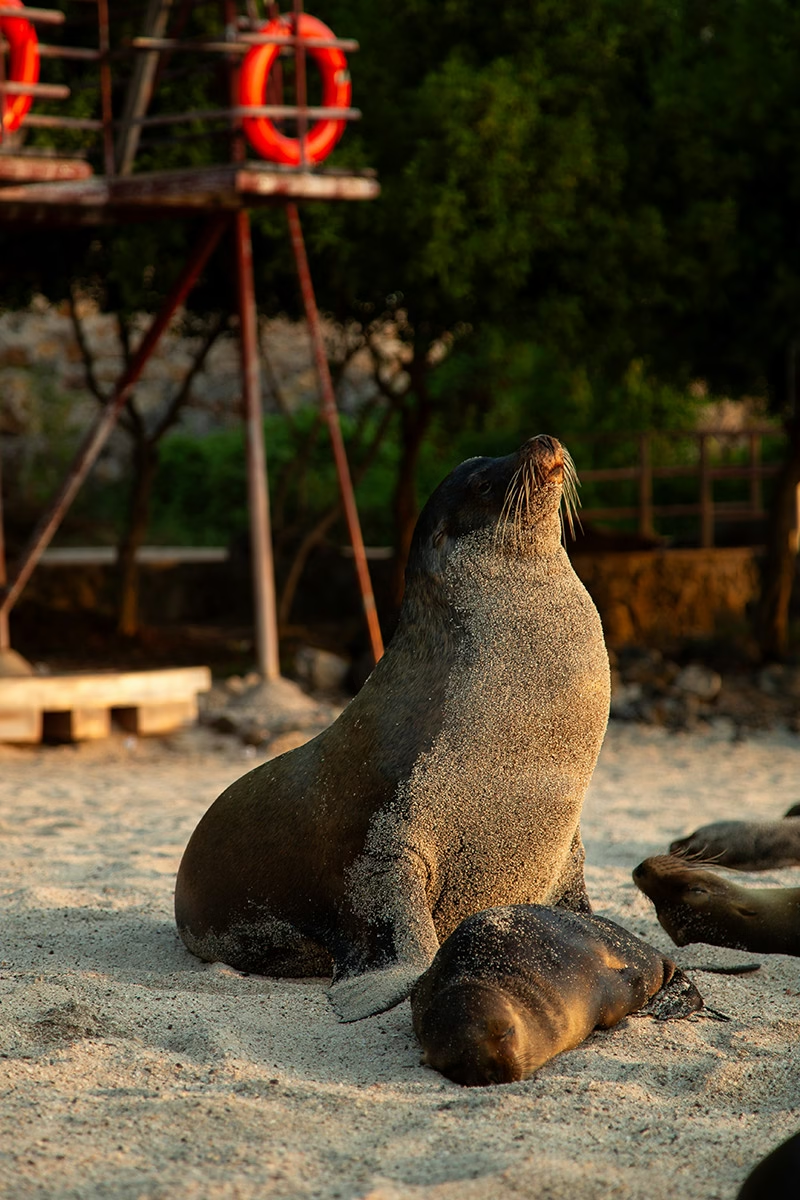
The Galápagos archipelago is home to species found nowhere else on the planet. But domestic dogs and cats — introduced over decades of human settlement — posed a direct and growing threat to that biodiversity.
For decades, the response was eradication. It was the only tool available. But it wasn’t working — populations kept regrowing, communities resisted it, and the suffering it caused was enormous.
Animal Balance proposed something different.
How we work
Compassion and coexistence in motion.
Starting in 2004, Animal Balance developed an integrated approach that addressed the problem on every level simultaneously: Regulatory, access to spay/neuter and education.
Free spay/neuter clinics and veterinary aid
High-quality, high-volume sterilization campaigns and veterinary aid open to every pet owner on the islands, at no cost.
Regulatory
Through institutional agreements we have fostered partnerships with government agencies to create a framework that promotes coexistence and prevention strategies.
Humane education
Programs in schools and communities that shifted how people thought about their animals and their responsibility toward the ecosystem they share.
The numbers
This is what two decades of commitment looks like.
These are not estimates. In 2024, Animal Balance completed the first full census of dogs and cats on Isabela Island, a verified, territory-wide baseline that allows us to track progress with precision year after year. The data confirms, from a recent census for control purposes, that there is a genuine demographic shift in the animal population, not a temporary reduction.
Communities now bring their animals voluntarily. They know us, they trust us, and they show up to every clinic.
Sterilization coverage in dogs on Isabela Island
Sterilization coverage in cats on Isabela Island
Years of operations
First full territory-wide census completed
Twenty two years in the field
From the first mission to a replicable model.
First mission on Isabela
Animal Balance launches its first sterilization campaign in the Galápagos, beginning on Isabela Island with support from local authorities. The first high-volume, high-quality sterilization campaign in the archipelago's history.
Expansion across the islands
In partnership with CIMEI, Animal Balance carries out the first large-scale multi-island campaigns. Free dog training classes and humane education workshops begin reaching community members across the archipelago.
Institutionalization
The Galápagos Biosecurity Agency (ABG) is established and formalizes its collaboration with Animal Balance. The first island-wide DHPP vaccination program for dogs is launched.
A decade of commitment
Annual clinics maintained without interruption. Humane education expanded across schools and neighborhoods. Free dog training becomes a fixture of community life.
First permanent clinic opens
With support from the Provincial Government (CGREG) and ABG, Animal Balance opens its first permanent veterinary clinic in Puerto Villamil, Isabela — offering free sterilization and wellness services year-round.
Post-COVID expansion
Animal Balance invites World Vets to join the effort in San Cristóbal, expanding regional capacity and deepening the network of organizations committed to the Galápagos model.
First full census completed
In partnership with local authorities, Animal Balance completes the first territory-wide census of dogs and cats on Isabela Island. The data confirms the scale of what has been achieved — and maps the road ahead.
Spay It Forward
In memory of local champion Dr. Diego Barrera, Animal Balance creates the Spay It Forward scholarship program for Ecuadorian veterinarians. Dr. Barrera's protégé, Dr. Edison Llambo, founded VetAID Ecuador, carrying the Galápagos model to the mainland.
First mission on Isabela
Animal Balance launches its first sterilization campaign in the Galápagos, beginning on Isabela Island with support from local authorities. The first high-volume, high-quality sterilization campaign in the archipelago's history.
Expansion across the islands
In partnership with CIMEI, Animal Balance carries out the first large-scale multi-island campaigns. Free dog training classes and humane education workshops begin reaching community members across the archipelago.
Institutionalization
The Galápagos Biosecurity Agency (ABG) is established and formalizes its collaboration with Animal Balance. The first island-wide DHPP vaccination program for dogs is launched.
A decade of commitment
Annual clinics maintained without interruption. Humane education expanded across schools and neighborhoods. Free dog training becomes a fixture of community life.
First permanent clinic opens
With support from the Provincial Government (CGREG) and ABG, Animal Balance opens its first permanent veterinary clinic in Puerto Villamil, Isabela — offering free sterilization and wellness services year-round.
Post-COVID expansion
Animal Balance invites World Vets to join the effort in San Cristóbal, expanding regional capacity and deepening the network of organizations committed to the Galápagos model.
First full census completed
In partnership with local authorities, Animal Balance completes the first territory-wide census of dogs and cats on Isabela Island. The data confirms the scale of what has been achieved — and maps the road ahead.
Spay It Forward
In memory of local champion Dr. Diego Barrera, Animal Balance creates the Spay It Forward scholarship program for Ecuadorian veterinarians. Dr. Barrera's protégé, Dr. Edison Llambo, founded VetAID Ecuador, carrying the Galápagos model to the mainland.
The next chapter: from Galapagos to the world
Our model can be replicated.
The Galápagos model didn’t just solve a local problem. It proved that a strategy built on compassion, free access, institutional partnerships, education, and consistent long-term commitment can permanently change the demographic reality of an animal population.
That proof became a formula and we can deploy it anywhere.
Join us in the field
Come work where it all began.
The Galápagos isn’t just Animal Balance’s proof of concept, it’s one of the most extraordinary places on Earth to practice veterinary medicine. If you’re an experienced veterinarian or veterinary technician who wants to put your skills to work in a place that genuinely needs them, this is the opportunity.
What you bring back is harder to quantify, the experience of working in one of the world’s most ecologically sensitive environments, inside a program with two decades of verified results, alongside a team that genuinely knows what it’s doing.
TO APPLY OR LEARN MORE CONTACT:
Jessica Gonzalez
jgonzalez@animalbalance.org
CLICK TO READ DETAILS
In order to apply to join our team either on Santa Cruz or Isabela Island, you must first read the following information and determine if this is the right fit for you. Travel to the islands can be costly and challenging, but it is in itself a whole adventure. Resources in the clinics are limited and we will kindly ask that you bring some supplies in to help our teams on the ground with products that are more difficult to obtain in Ecuador.
The cost to join us in Galapagos is $500 per person. This covers your entry fee into Galapagos as a volunteer, lunch at the clinic each day, your volunteer visa and assistance with booking flights and local hotels (we will not do this for you but can help answer questions about logistics and locations of hotels and flights). This fee also helps us to purchase supplies for the clinic in which you will be working. You will need to plan for two days of travel on both ends of your trip. So when you look at our clinic dates, plan to leave two days prior and return home roughly two days later than the last day of clinic. Your travel will include many plane flights, a number of water taxis, at least one bus, a 45 minute taxi ride and a three hour boat ride to Isabela if you choose to go to that island, we also promise breathtaking views and human animal interactions like you have never experienced in the wild. You may arrive a few days early or stay a few days later, but you are bound to the dates listed on your visa and may not stay more than a few extra days on either end of the clinic.
The clinic on Isabela is rustic and was previously used as a fire station. This is not your typical US clinic, however we do have anesthesia machines and autoclave. We ask that you help our local team by bringing in flea and tick medication, leashes and collars and other supplies that are more expensive and difficult to obtain in Ecuador. The clinic on Santa Cruz island is at the Biosecurity Agency’s (ABG) premises, this one is more modern but is still quite different from what you may be used to and therefore you will need to adjust your expectations accordingly. There will be both Spanish and English speaking veterinarians and technicians at this clinic.
Still interested? Great! We’d love to hear from you. Please email mgram@animalbalance.org with the dates you are interested in and we will arrange for a phone interview with our Galapagos Program Director, Jessica Gonzalez. You may also email Jessica directly at jgonzalez@animalbalance.org.